
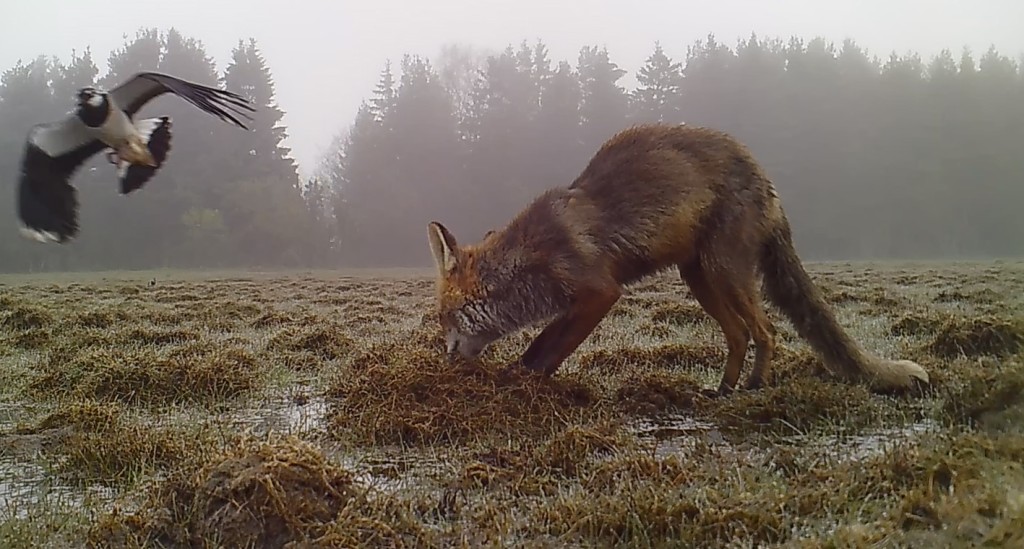
"Studies carried out in recent years show that the unnaturally high number of small predators threatens the birds of coastal meadows as several protected bird species that are already in poor condition are also suffering. As a result, the Environmental Board has decided to fund an experiment that scientists believe could improve the status of birds," said Rainer Vakra, Director General of the Environmental Board.
According to Triin Kaasiku, a doctoral student in nature conservation at the University of Tartu, the results of the research were conducted in Lääne County, Pärnu County, and Hiiu County in the previous three years is sad. "Although it is the case in the wild that the fox always eats some bird nests, at the moment there is something wrong with the coastal meadows: as a result of nest looting, as many as 86% of the nests of birds nesting on the ground are destroyed. Thus, the reproduction of populations is not sustainable and, for example, the local populations of southern dunlin and ruff are in danger of extinction," Kaasiku explained.
Kaasiku's research revealed that the fox, and in Lääne County and Pärnu County, also the jackal are the main small predators looting bird nests.
During the project "LIFE-IP ForEst&FarmLand," the local hunting communities of the Estonian Hunters' Society will hunt small predators in five research areas of the University of Tartu over the next two months. The hunt is carried out on coastal meadows selected by researchers, where attempts are made to regulate the number of foxes, jackals, and common raccoon dogs. To assess the effectiveness of the measures taken to protect the birds, the success rate of hatchings during the spring breeding season is measured.
Jaanus Vaiksoo, the project manager of the Hunters' Society, confirmed that hunters are interested in participating in the project and the results of the research in order to find out whether regulating the number of small predators will bring relief to nest looting. "If we can contribute to the protection of Estonian birds, then this is also a value and a goal in itself," said Jaanus Vaiksoo.
Haapsalu Hunters' Society from Lääne County, Tuudi and Massu Hunters' Societies from Pärnu County, Suuremõisa and Emmaste Hunters' Societies from Hiiu County and Muhu Hunters' Society are participating in the project. The task of the hunters' societies is to hunt foxes, jackals, and common raccoons in the spring nesting areas of meadow breeding waders in the coastal meadows selected by the researchers in February and March according to the hunting regulations.
The pilot project "Regulation of the number of small predators in coastal meadows important for species protection" is part of a larger restoration of coastal meadows in Western Estonia, in the course of which the meadow area is expanded, and the dry stands with no nature value surrounding the meadows are removed. The more tree stands and shrubs there are in the meadow areas, the more suitable the area is for foxes and common raccoons, who can easily find a hiding place there.
Additional information:
Eike Tammekänd,
Head of the Nature Conservation Bureau of the Environmental Board
5699 6334
Jaanus Vaiksoo,
Estonian Hunters' Society
552 6032
Triin Kaasiku,
Department of Zoology, University of Tartu
524 0989

