
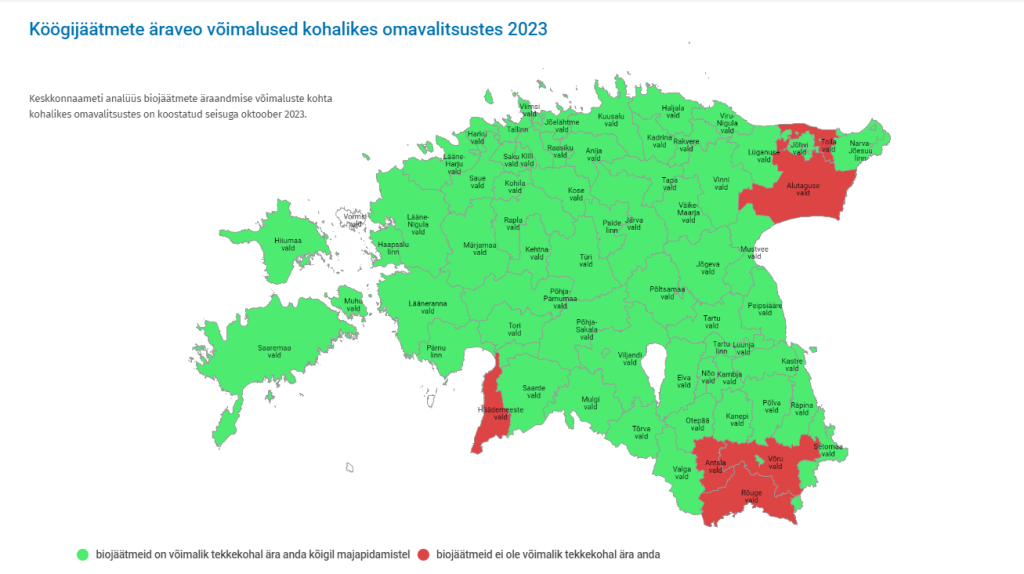
It is most convenient for the resident if the separately collected waste can be dropped off near their home. Waste collection organized by the local government is one of the easiest ways to ensure this. The overview of the waste management of local governments by the Waste Bureau of the Environmental Board shows that the organization of waste transport has become more convenient for residents in ten municipalities. Only six municipalities have not organized transportation of bio-waste. "Local governments have done a good job, enabling residents to hand over bio-waste to a waste carrier. Now everyone has to start taking advantage of these opportunities and contribute to reducing the amount of waste," said Helen Akenpärg, head of the Waste Buraeu of the Environmental Board.
Biodegradable waste fills one third of mixed waste containers and produces greenhouse gases in anaerobic conditions at the landfill. "In order for bio-waste not to end up in a landfill or incineration, it must be collected separately. If we collected this mass separately, the amount of waste deposited in the landfill would decrease dramatically," explained Akenpärg.
Bio-waste thrown into mixed household waste pollutes practically the entire mass of waste and thus takes the opportunity to recycle other materials as well. "If bio-waste ends up in a landfill together with mixed household waste, then we have wasted a large amount of valuable material that could be used to produce biogas or compost," said the head of the waste office.
Composting in the same household where bio-waste is generated is equally good. "No one is forced to give away bio-waste if they want to compost it. It is important that bio-waste does not end up in mixed household waste. Although on-site composting is a very good way to recycle bio-waste, composting cannot be the only way to recycle bio-waste in any municipality. On-site composting requires special conditions, work and the possibility to use the resulting compost soil. The rules for home composting are set by the local government, and the waste management regulations help to choose the appropriate method of composting," said Akenpärg.
The number of municipalities where the collection of packaging waste, bulky waste, paper and cardboard, and kitchen and canteen waste has been organized has also increased. "In order to fulfill the material recycling goals and the set target numbers, the organization of waste transport collected by type is essential. For example, 80-90% of the separately collected waste paper ends up in circulation again, mostly the waste paper is exported to Finland, Latvia or Lithuania," explained the head of the waste office.
All the member states of the European Union, including Estonia, have set the goal that by 2025, 55% of the generated household waste will be recycled and not deposited in a landfill or burned for energy.
Results of the review of waste management of local governments:
- Kaart: Köögijäätmete äraveo võimalused kohalikes omavalitsustes 2023
- Kaart: liigiti kogutud jäätmete ära andmise võimalused korraldatud jäätmeveos, võrdlus 2022/2023
- Liigiti kogutud jäätmete äravedu kohalikes omavalitsustes
This text was translated with the help of Google Translate.

